Interview & Media: A Practical Guide to Mastering Interviews and Media Presence
A practical guide to navigating interviews and media for standout communication and impact.
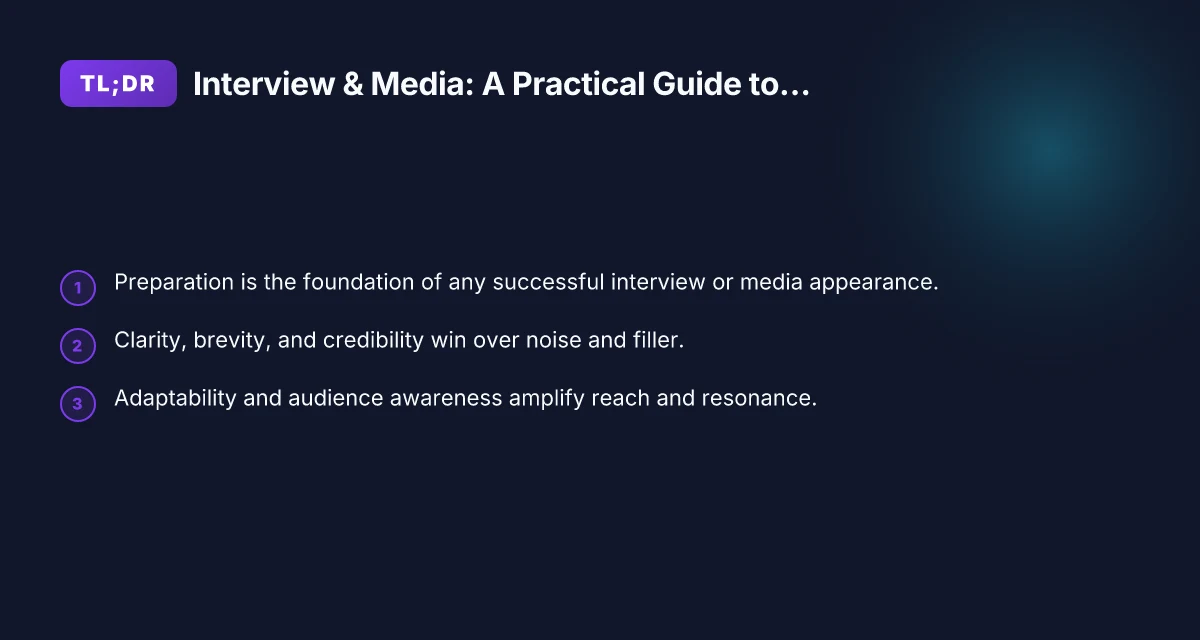
Interviews and media appearances can feel like high-stakes performance, but with a clear plan, you can translate expertise into compelling, trusted communication. This guide covers practical steps to prepare, conduct, and follow up on interviews, while building a media-friendly presence that aligns with your goals and values.
Comparison of Interview Prep Approaches by Stage
| Stage | Focus | Typical Time Investment | Key Deliverables | Pros | Cons |
|---|---|---|---|---|---|
| Hesitation to clarity | Identify gaps; set goals | Moderate | Prep blueprint | Builds confidence; clear path | Time-consuming upfront |
| Message crafting | Clarity, brevity, credibility | Moderate | Core messages | Memorable, shareable | May oversimplify complex topics |
| Formats matter | Media tailoring | Low–Moderate | Format-specific scripts | Relevance to outlet | Requires format upkeep |
| Tough questions | Poise under pressure | High | Q&A tactics | Readiness; composure | Stressful to simulate |
| Nonverbal language | Body cues | Low | Observation notes | Improves presence | Hard to measure |
| Media-ready toolkit | Assets library | Moderate | Decks, bios, hooks | Quick responsiveness | Maintenance overhead |
Compiled November 2026; check the provider's site for current details.
Getting from hesitation to clarity: the interview prep blueprint
Preparation is the fastest route from uncertainty to confident delivery.
- Define your objective: What should the audience take away? What actions should they consider?
- Know your core messages: 2–3 talking points that reflect your expertise and align with your objective.
- Anticipate questions: Prepare responses for common interview formats (print, broadcast, podcast, panel) and for tough or controversial questions.
- Gather your evidence: Have facts, data, stories, and quotes ready. If you reference numbers, know your sources.
- Practice with purpose: Rehearse aloud, record yourself, and test pacing. Practice transitions between points.
A strong prep routine reduces scrambling under pressure and helps you stay on message when the conversation veers off course. Create a one-page briefing for yourself with the key messages, audience, and potential questions, plus a short bio and the ask you want to convey.
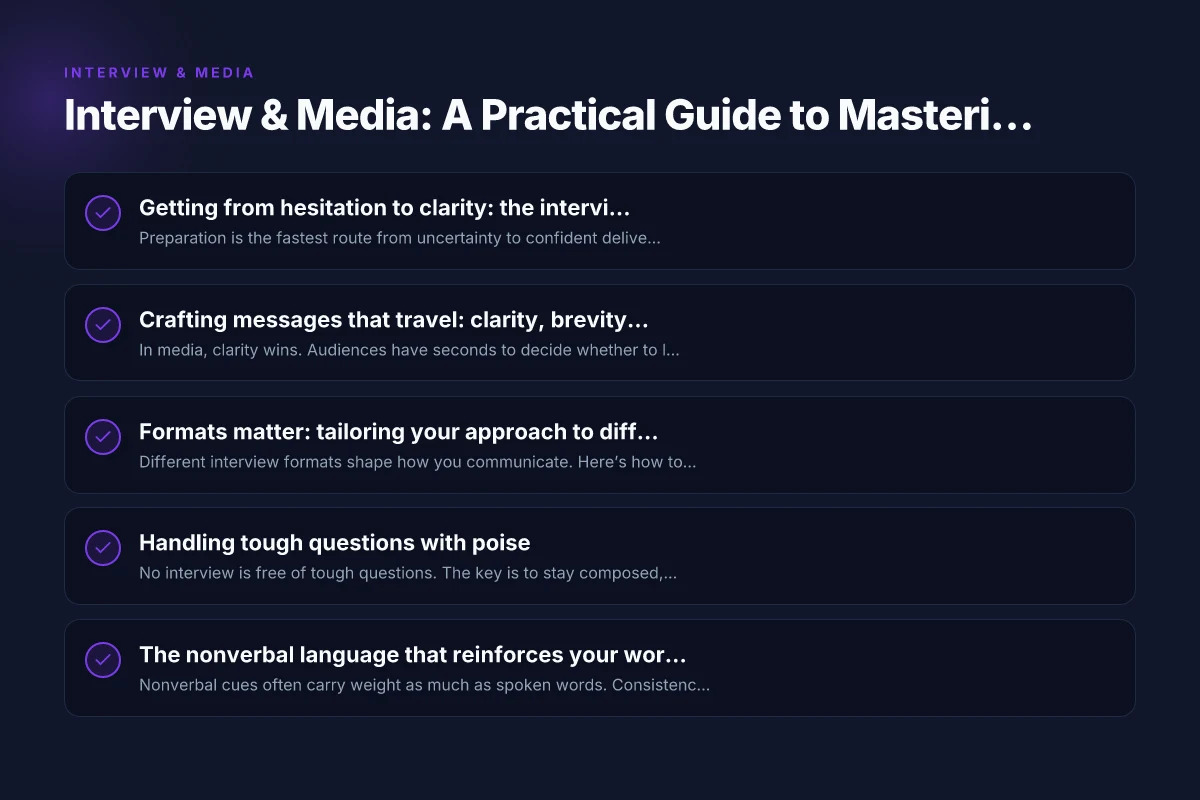
Crafting messages that travel: clarity, brevity, credibility
In media, clarity wins. Audiences have seconds to decide whether to listen, so be clear and concise.
- Use plain language: Avoid jargon, unless you’re sure the audience understands it. If you must use a technical term, define it briefly.
- Tell a story: Humans connect with stories. Pair a point with a brief anecdote or case study.
- State your takeaway early: Lead with the answer or conclusion, then provide supporting evidence.
- Quantify when possible: Numbers anchor statements. If you can’t share exact figures, offer ranges or relative terms (e.g., “double-digit growth”).
- Address the counterpoint: Acknowledge an alternative view and then explain why your perspective matters.
Credibility is earned through accuracy, transparency, and the absence of spin. Always verify statistics, attribute quotes, and avoid overclaiming. If you don’t know something, say so and offer to follow up with reliable information. BUILDING MAINTENANCE & CLEAN EXPO 2019
Formats and Outcomes by Media Channel
| Channel | Preferred format | Message length | Visual/Audio needs | Outcome expectation | Risk level |
|---|---|---|---|---|---|
| TV | Short statements; soundbites | 10–20 seconds | Studio, backdrop | Broad reach | High |
| Radio | Conversational; quotable lines | 30–60 seconds | Clear audio; minimal effects | Frequency, recall | Medium |
| Longer quotes; background | 100–200 words | Photos; captions | Depth, context | Low | |
| Online video | Hooks early; chapters | 60–120 seconds | B-roll; captions | Engagement, shares | Medium |
| Podcasts | Story arc; narrative | 5–10 minutes | Studio-quality audio | Loyalty; authority | Low |
| Social snippets | Micro-statements | 5–15 seconds | Subtitles; thumbnails | Virality; CTA | Medium |
Compiled November 2026; check the provider's site for current details.
Formats matter: tailoring your approach to different media
Different interview formats shape how you communicate. Here’s how to tailor for common scenarios:
- Print interview: Be quotable, answer with standalone sentences, and think in 2–3 sentence blocks. Print sees your words in larger context, so avoid filler and hedging.
- Radio/podcast: Speak in a natural, conversational cadence. Use pausing and emphasis to guide listeners. Short sentences translate well to sound bites.
- TV news: Visuals matter. Emphasize concrete examples and keep responses to 20–30 seconds. Anticipate moments when graphics, B-roll, or demonstrations can reinforce your point.
- Online video: Engage early with a hook, maintain eye contact with the camera, and structure your answer with a clear arc: problem, solution, impact.
- Panel or press briefing: Keep responses concise, acknowledge other perspectives, and steer back to your core messages with a bridging technique.
Table: Key formatting for interview formats EXHIBITING: A Complete Guide to Showcasing Your Work Effectively
| Format | Primary goal | Best practices | Typical length cue |
|---|---|---|---|
| Clear quotes and detail | Short sentences, quotable sound bites, precise facts | 1–2 paragraphs per answer | |
| Radio/Podcast | Engage audience through voice | Conversational, stories, natural pace, avoid jargon | 60–90 seconds per topic |
| TV/Video | Visualizable, quotable | Concrete examples, minimal jargon, strong sound bites | 20–30 seconds per answer |
| Panel/Live | Balance and credibility | Bridging, concise answers, acknowledge others | 1–2 minutes per question |
Handling tough questions with poise
No interview is free of tough questions. The key is to stay composed, steer back to your messages, and provide value.
- Acknowledge the question: Show you hear the concern.
- Bridge to your messages: Use a bridging phrase to land on your points.
- Resist defensiveness: Stay factual, avoid blame or personal attacks.
- Offer a constructive takeaway: End with a practical implication or action.
- If you don’t know: Offer to follow up with verified information and provide a timeline.
Practice scenarios with a trusted colleague or media trainer, and build a set of trusted phrases you can deploy in pressure moments. The goal is to get your messages out, not to win every point in an argument.
The nonverbal language that reinforces your words
Nonverbal cues often carry weight as much as spoken words. Consistency between what you say and how you present yourself strengthens trust.
- Eye contact: For in-person and video, look toward the interviewer or camera as you speak.
- Posture: Sit or stand upright to convey confidence and openness.
- Facial expressions: Align emotions with the message. Avoid nodding along too much or freezing.
- Pace and rhythm: Vary your pace to emphasize key points. Use pauses for emphasis.
- Gestures: Use deliberate, natural gestures to illustrate ideas, not to distract.
For video interviews, ensure good lighting, a clean background, and clear audio. These elements reduce cognitive load on the audience and keep the focus on your message. 開催概要: A Complete Guide to Understanding Event Details (開催概要)
The interview toolkit: building a reliable media-ready set
Equip yourself with a portable, repeatable constellation of assets that simplify interviews and ensure consistency.
- Core message map: A concise, 2–3 sentence summary of who you are, what you do, and why it matters.
- 1-pager bio: A short, practitioner-friendly bio for introductions, with sector relevance and current roles.
- Key data points: 3–5 numbers or facts you can quote safely in most conversations.
- Anecdotes bank: 4–6 short stories or examples that illustrate your points.
- Credibility anchors: Any awards, affiliations, or notable achievements you can mention naturally.
- Contact and follow-up plan: A clear process for post-interview engagement and resource sharing.
With these assets, you can adapt quickly across formats and topics, maintaining a consistent, authentic voice.
Social media extension: turning interviews into a broader impact
Media appearances can be amplifiers for your broader narrative. Use your interview outcomes to inform social channels and thought leadership.
- Transcribe and excerpt: Create handy snippets, pull-quotes, and micro-stories from interviews for social posts.
- Cross-post strategy: Share the interview on your channels with a short, value-driven caption and a link to the full piece.
- Follow-up content: Write a short article or blog post that expands on themes touched in the interview, with data and references.
- Engage responsibly: Respond to audience questions or comments with thoughtfulness and accuracy.
- Align with your personal brand: Ensure tone, topics, and visuals reflect your broader brand platform.
A thoughtful media strategy extends the life and impact of a single interview, turning it into ongoing conversations with your audience. 2018年度実績: A Comprehensive Look at the 2018 Performance and Outcomes
Practice and Improvement Metrics Table
| Area | Metric | Current Status | Target Status | Evidence/Source | Notes |
|---|---|---|---|---|---|
| Practice frequency | sessions per week | [yes / no / number] | [number] | logs | Consistency matters |
| Quality feedback | feedback instances | [yes / no / number] | [number] | reviews | Seek diverse voices |
| Message consistency | variation score | [low/med/high] | [low] | recordings | Aligns across formats |
| Nonverbal cues | presence rating | [poor/fair/good/excellent] | good | observer notes | Body language matters |
| Incident handling | tough-question drills | [yes/no] | yes | rehearsal log | Realism improves readiness |
| Media toolkit Update | cadence | [monthly/quarterly/annually] | quarterly | asset inventory | Keep current |
Compiled November 2026; check the provider's site for current details.
Practice, performance, and continuous improvement
Like any skill, interview proficiency improves with deliberate practice and feedback.
- Mock interviews: Schedule regular practice sessions with colleagues or coaches. Vary topics and formats.
- Review and refine: After every interview, note what worked well and what felt clunky. Update your message map and anecdotes.
- Track outcomes: Monitor media reach, audience engagement, and any actions taken as a result of the interview.
- Seek feedback from hosts: If appropriate, ask for constructive feedback on clarity, pace, and relevance.
Consistency over time yields recognizable, trusted media presence. 来場対象: Who Can Attend and How to Determine Eligibility
Final recommendation: build a sustainable interview-and-media program
If you want to become more effective in interviews and media appearances, invest in a sustainable program rather than one-off efforts.
- Start with a clear objective and core messages.
- Build assets you can reuse across appearances.
- Practice regularly in formats you actually face.
- Develop a social media extension plan to magnify impact.
- Measure outcomes and iterate.
A well-structured approach reduces stress, elevates credibility, and helps you reach the right audiences with your essential message. Whether you’re sharing research, advocating for a cause, or promoting a product, the combination of preparation, clarity, and audience awareness will deliver the best results.
沈清禾负责免费VPN实测,记录流量上限、速度限制、广告和隐私条款。