BUILDING MAINTENANCE & CLEAN EXPO 2019
A comprehensive overview of the BUILDING MAINTENANCE & CLEAN EXPO 2019, its themes, exhibitors, and practical takeaways for facilities professionals.
BUILDING MAINTENANCE & CLEAN EXPO 2019 brought together facilities managers, building owners, contractors, and service providers to explore the latest tools, techniques, and trends in building operation and cleaning. Held in [city], the event gathered manufacturers, distributors, and industry experts to share product demonstrations, case studies, and practical sessions. This article distills the core themes, notable exhibitors, and key takeaways that attendees can apply to their own sites.
Comparison of expo relevance by topic
| Topic | Relevance to 2019 expo | Practical applicability | Key takeaway | Suggested action |
|---|---|---|---|---|
| Why the expo mattered in 2019 | high | actionable | strong | engage exhibitors |
| Highlights from exhibitors | medium | actionable | varied | follow demos |
| Practical takeaways for facilities teams | high | highly actionable | implementable | assign tasks |
| Buyer decision framework | medium | strategic | framework in place | map to RFPs |
| Networking and sourcing | medium | viable | connections created | build list |
| Trends that shaped expo 2019 | high | strategic | trend alignment | plan changes |
Compiled November 2026; check the provider's site for current details.
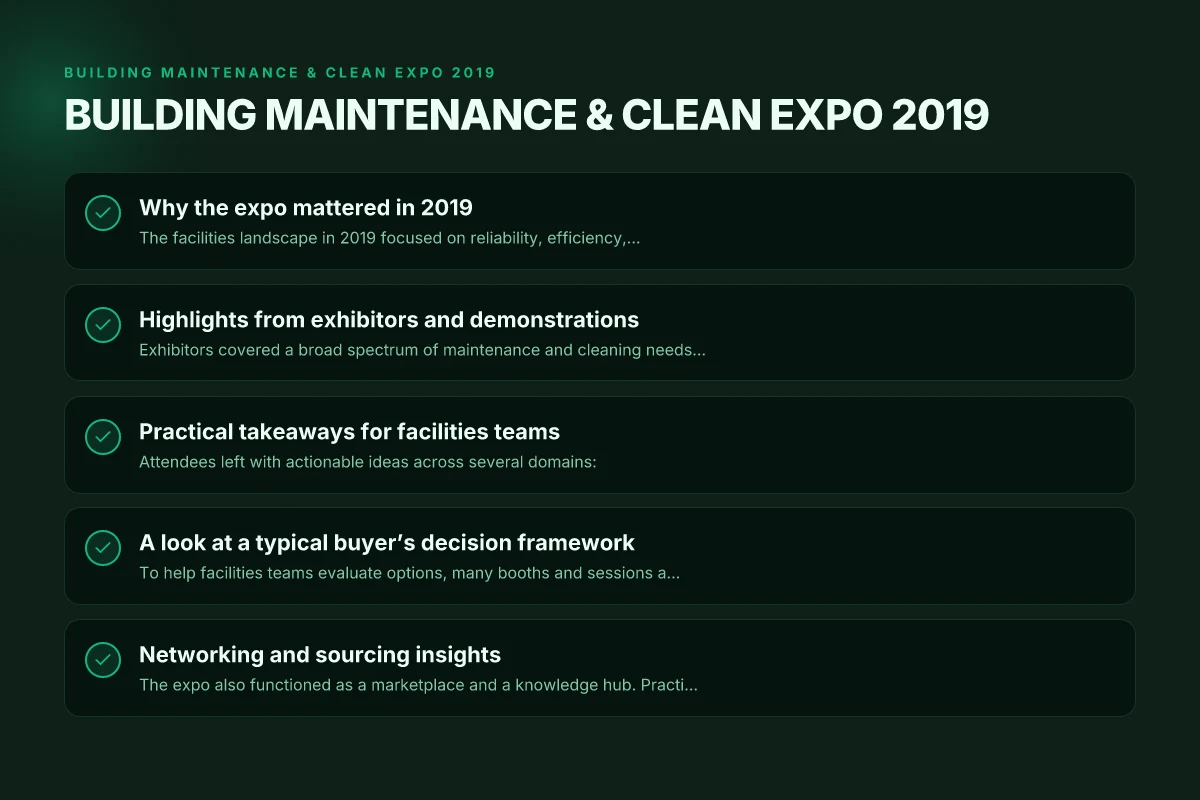
Why the expo mattered in 2019
The facilities landscape in 2019 focused on reliability, efficiency, and sustainability. Building operators faced increasing expectations for clean, safe environments with lower energy and water usage. The expo responded with:
- Live demonstrations of automation and smart building technologies
- Innovations in eco-friendly cleaning products and methods
- Panels on maintenance strategies, asset lifecycle planning, and risk management
- Opportunities to compare multiple vendors side by side
These elements helped attendees evaluate new equipment, software, and services that could reduce downtime, extend asset life, and lower operating costs.
Highlights from exhibitors and demonstrations
Exhibitors covered a broad spectrum of maintenance and cleaning needs. Notable categories included:
- Cleaning equipment: vacuum robots, scrubbing machines, pressure washers, microfiber systems
- Building maintenance tools: lifts, ladders, power tools, fall protection
- Facility management software: CMMS, work order systems, asset tracking
- Environmental and safety products: chemical-free sanitation, PPE, spill control
- Energy and water efficiency tech: sensors, metering, HVAC optimization
Case studies often showcased a facility that replaced outdated equipment with a bundled solution, resulting in measurable improvements in productivity and compliance. Live demos gave attendees a tactile sense of performance, noise levels, throughput, and maintenance requirements. EXHIBITING: A Complete Guide to Showcasing Your Work Effectively
Practical takeaways for facilities teams
Attendees left with actionable ideas across several domains:
Maintenance planning and asset lifecycle
- Implement a formal preventive maintenance program driven by manufacturer recommendations and real-world usage data.
- Use CMMS to schedule tasks, track parts, and generate reports for audits and budgeting.
- Establish criticality rankings for assets to prioritize inspections and spare parts stocking.
Cleaning efficiency and safety
- Adopt microfiber cleaning systems and electrostatic sprayers to improve coverage and reduce chemical use.
- Consider automated or semi-automated cleaning equipment for high-traffic areas to scale operations.
- Invest in slip-resistant flooring and proper signage to minimize liability and downtime.
Sustainability and cost savings
- Explore low-VOC cleaners and green-certified products to protect occupants and the environment.
- Install metering on water and energy use to identify leaks or efficiency opportunities.
- Transition to light-emitting diode (LED) lighting and smart controls to reduce energy spend.
Workforce and training
- Use on-site or virtual training modules to keep maintenance staff up to date on equipment and safety procedures.
- Create standardized operating procedures (SOPs) to reduce variation and mistakes.
- Encourage cross-training to maintain operations during staff shortages.
Buyer decision framework options showcased
| Framework element | Description (short) | Relevance to buyers | Typical outcome | Recommended use |
|---|---|---|---|---|
| TCO / lifecycle cost | total cost of ownership | high | lower future costs | compare options |
| ROI expectations | return on investment | medium | prioritized investments | justify purchases |
| Vendor credibility | credibility signals | high | trust built | due diligence |
| Compliance & safety | regulatory alignment | high | risk mitigation | screen vendors |
| Total risk assessment | risk factors | medium | risk scores | risk-adjusted picks |
Compiled November 2026; check the provider's site for current details.
A look at a typical buyer’s decision framework
To help facilities teams evaluate options, many booths and sessions aligned with a simple decision framework. The below table contrasts common equipment or software choices against key considerations: 開催概要: A Complete Guide to Understanding Event Details (開催概要)
| Category | Priority Considerations | Pros | Cons |
|---|---|---|---|
| Cleaning machines | Throughput, reliability, maintenance needs | Higher productivity, longer life | Upfront cost, training required |
| CMMS software | Integration with current systems, user adoption | Streamlined work orders, better data | Implementation time, change management |
| Solar or energy-saving tech | Return on investment, compatibility with existing systems | Lower operating costs, ESG benefits | Upfront cost, maintenance of new tech |
| Safety and PPE | Compliance, comfort, fit | Reduced risk, better morale | Ongoing costs, proper fit required |
This framework helps teams compare options side by side and make trade-offs aligned with site-specific priorities, budgets, and risk tolerance.
Networking and sourcing insights
The expo also functioned as a marketplace and a knowledge hub. Practical moves for attendees included:
- Collecting product literature, specs, and warranties for later comparison
- Scheduling follow-up meetings with vendors who demonstrated value in line with site needs
- Connecting with peers to share lessons learned on asset management and cleaning protocols
- Attending roundtables and demonstrations that addressed regulatory updates and standards compliance
For procurement teams, an effective approach was to create a shortlist of three candidates per category and request proof-of-concept trials or pilot programs where feasible.
Trends that shaped BUILDING MAINTENANCE & CLEAN EXPO 2019
Several overarching themes emerged across sessions and booths: 2018年度実績: A Comprehensive Look at the 2018 Performance and Outcomes
- Smart facilities and data-driven operations: Sensors, IoT devices, and mobile dashboards began to unlock real-time visibility into building performance, enabling proactive maintenance and cleaner operations.
- Health, safety, and compliance focus: Beyond basic OSHA guidelines, there was emphasis on occupant well-being, air quality, and safer chemical usage.
- Sustainability as a core metric: Green cleaning products, energy-efficient equipment, and water conservation were not secondary considerations but core decision criteria.
- Modular and scalable solutions: Stakeholders sought equipment and software that could scale with facility growth, seasonal demands, or portfolio expansion.
- Training and change management: The best tools fail without effective training and user buy-in. The expo highlighted strategies to accelerate adoption.
Networking and sourcing priorities for facilities teams
| Priority area | What to collect | Signals to watch | Next steps | Timeframe |
|---|---|---|---|---|
| Supplier contacts | contact info | responsive & helpful | follow up | within 2 weeks |
| Demos and specs | product specs | clear data | request proposals | 1 month |
| Price ranges | ballpark pricing | transparent quotes | negotiate | before budget cycle |
| Warranty & service | warranty terms | solid coverage | secure SLAs | before signing |
| Training & support | training options | availability | plan onboarding | start onboarding |
| Case studies | real-world results | credible results | request references | Q2 review |
Compiled November 2026; check the provider's site for current details.
Notable sessions and takeaways
- Keynote addresses emphasized tying maintenance strategies to total cost of ownership (TCO) rather than upfront purchase price.
- Roundtables explored the integration of cleaning operations with facility management systems to eliminate data silos.
- Demonstrations compared traditional mops and buckets against modern microfiber systems, revealing significant time savings and improved sanitation metrics.
- Vendor workshops offered hands-on trials with equipment showing improvements in noise levels, efficiency, and ergonomics.
How to apply the expo insights to your site
- Start with a needs assessment: Map assets, current maintenance schedules, and cleaning routines. Identify pain points such as recurring downtime, excessive chemical use, or inconsistent cleaning quality.
- Build a pilot plan: Select one or two categories (e.g., CMMS implementation and microfiber cleaning program) and design a small-scale test with clear success metrics.
- Create a vendor shortlist: Based on demonstrations and information collected, rank vendors by compatibility with your systems, support availability, and total cost of ownership.
- Develop an implementation timeline: Align procurement with budgeting cycles, ensuring staff training and change management are included.
- Measure and iterate: Track KPIs such as downtime, response times, cleaning cycle times, energy use, and chemical consumption. Use data to adjust the plan.
Final recommendation
If you are a facilities professional looking to modernize building maintenance and cleaning operations, BUILDING MAINTENANCE & CLEAN EXPO 2019 offered a valuable snapshot of where the industry was headed and practical steps to adopt new tools. Start with a focused, data-driven approach: pick two high-impact areas (e.g., CMMS enablement and a green cleaning program), run a controlled pilot, and use the expo learnings to inform vendor selections and internal processes. The most successful outcomes come from combining hands-on demonstrations with structured change management, clear KPIs, and ongoing staff training.
沈清禾负责免费VPN实测,记录流量上限、速度限制、广告和隐私条款。