EXHIBITING: A Complete Guide to Showcasing Your Work Effectively
Learn how to plan, prepare, and present compelling exhibitions that engage audiences and showcase your work at its best.
The word EXHIBITING covers the act of presenting and displaying work to others. Whether you’re an artist, a photographer, a curator, or a brand manager, exhibiting is about more than placing objects on a wall. It’s a carefully orchestrated communication strategy that invites viewers to engage, interpret, and remember what they’ve seen. In this guide, you’ll find a practical, field-tested approach to planning, designing, and executing exhibits that resonate with audiences and fulfill your goals.
Comparing exhibit purposes and goals
| Aspect | Purpose clarity | Audience impact | Scope alignment | Budget alignment | Timeframe |
|---|---|---|---|---|---|
| Understanding the purpose | clear | strong | aligned | realistic | defined |
| Curation goals | defined | impactful | aligned | feasible | staged |
| Story goals | coherent | engaging | consistent | affordable | time-bound |
| Accessibility goals | inclusive | usable | compliant | affordable | achievable |
| Sustainability goals | durable | long-term | scoped | cost-effective | phased |
Compiled November 2026; check the provider's site for current details.
Understanding the purpose of your exhibit
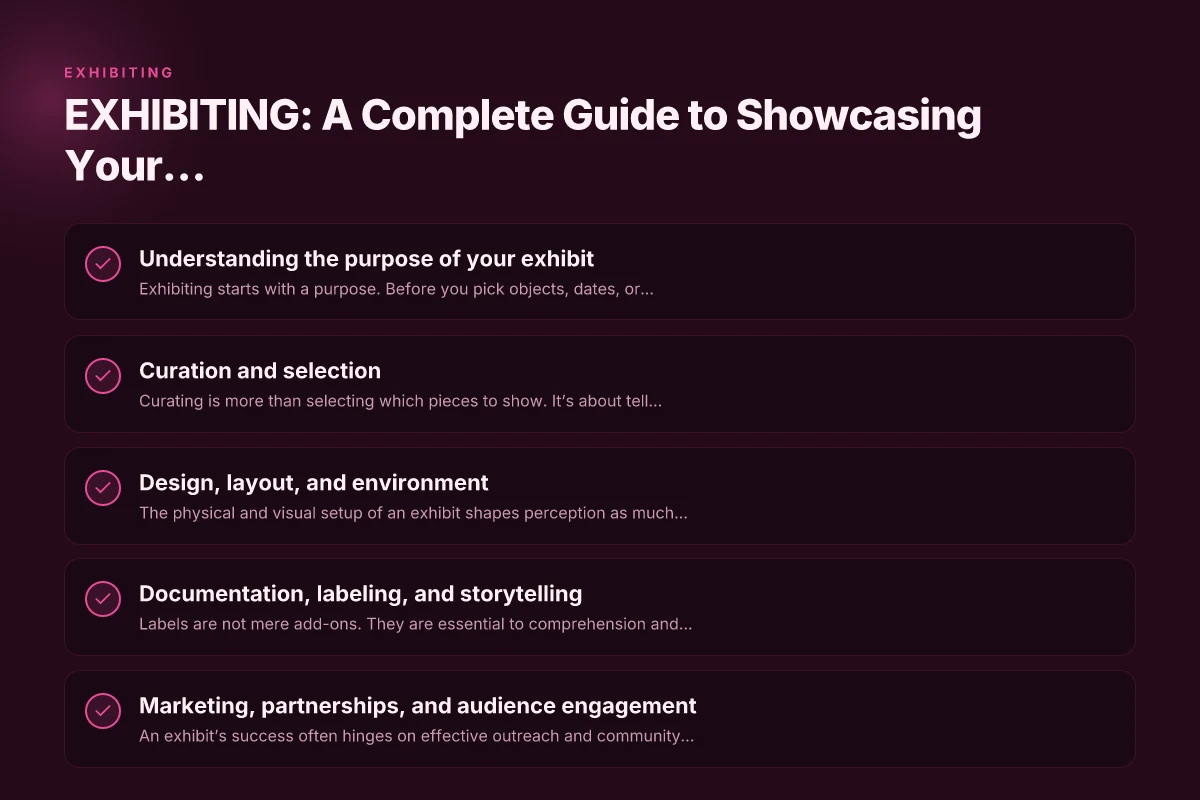
Exhibiting starts with a purpose. Before you pick objects, dates, or venues, clarify why you’re exhibiting.
- Define your objective: Is it to sell work, gain exposure, tell a story, or educate?
- Identify your audience: Who do you want to reach? Museums, galleries, schools, local communities, or online viewers?
- Set measurable goals: Number of visitors, press coverage, social media engagement, or sales targets.
Translating goals into an exhibition concept
A strong concept anchors all decisions. It’s the narrative thread that ties disparate pieces together.
- Create a unifying idea or theme.
- Align every element to support that theme: works, labels, layout, and activities.
- Prepare an elevator pitch: a one-sentence description you can share with staff, collaborators, and potential partners.
Curation and selection
Curating is more than selecting which pieces to show. It’s about telling a coherent story and managing viewer experience.
- Inventory and categorize: what you have, what complements it, and what should be highlighted.
- Quality over quantity: fewer pieces can create stronger impact.
- Balance media, scale, and medium: mix formats if appropriate.
- Consider the visitor journey: entry, peak moments, and a thoughtful exit.
- Accessibility and inclusivity: ensure diverse audiences can engage with the work.
How to approach sensitive or controversial material
If your exhibit includes provocative content, plan for context and dialogue. 開催概要: A Complete Guide to Understanding Event Details (開催概要)
- Provide ample context: labels, wall text, and artist statements.
- Include trigger warnings or audience advisories when needed.
- Offer viewer resources: QR codes to further reading, artist talks, or community discussions.
- Prepare for questions and pushback with ready responses.
Design, layout, and environment
The physical and visual setup of an exhibit shapes perception as much as the works themselves.
- Space planning: measure dimensions, traffic flow, and sightlines.
- Lighting: use a combination of ambient, accent, and task lighting to reveal texture and detail. Avoid harsh glare.
- Color and mood: choose a palette that enhances the works and doesn’t distract.
- Labels and wall text: keep typography legible. Place near the works they describe.
- Accessibility: ensure ramps or elevators are available. Provide alternative formats for captions and labels.
- Interactivity: consider digital displays, touchscreens, or guided tours if appropriate.
The single most impactful layout approach
A clear focal point with a gradual perimeter journey often works best. Place the main piece near the entrance or center, then guide viewers with a logical progression through related pieces and supporting materials.
Documentation, labeling, and storytelling
Labels are not mere add-ons. They are essential to comprehension and memory.
- Artist statements: provide context, process, and intent without overwhelming the viewer.
- Technical details: materials, dates, dimensions, and provenance in compact formats.
- Captions: concise, informative, and accessible. Use a consistent voice across all labels.
- Documentation: high-quality images of each work for catalogs, press kits, and online listings.
- Archivability: keep records of loans, insurance, and condition reports for every object.
A practical labeling system
- Title (Year), Medium, Dimensions
- Context note: 1–2 sentences expanding on concept
- Credits: Artist, lender, curator, contributor
- QR code: links to extended content or artist interview
Marketing, partnerships, and audience engagement
An exhibit’s success often hinges on effective outreach and community involvement. 2018年度実績: A Comprehensive Look at the 2018 Performance and Outcomes
- Create a simple, compelling message: what makes this exhibit worth visiting?
- Develop a triad of channels: in-gallery materials, digital presence, and press outreach.
- Build partnerships: schools, local businesses, arts councils, libraries.
- Public programs: artist talks, tours, workshops, panel discussions.
- Social media strategy: behind-the-scenes content, process videos, and previews.
- Invitations and ticketing: clear pricing, accessibility, and time slots to manage crowds.
A small but effective outreach plan
- Week 1: announce the exhibit on your website and social channels.
- Week 2: share a teaser interview with the artist or curator.
- Week 3: issue a press release to local outlets and art writers.
- Week 4: host a public program and offer a guided tour.
Logistics, insurance, and practical considerations
Exhibiting involves careful logistical planning.
- Budget: allocate for printing, framing, installation, insurance, and Pr.
- Loan agreements: track lenders, return dates, and condition reports.
- Transport and installation: hire professional installers if needed. Ensure walls and plinths accommodate weights.
- Insurance: coverage for damage, loss, or theft. Verify coverage terms.
- Safety and compliance: fire exits, occupancy limits, covid considerations if relevant.
- Documentation: keep a running inventory and schedule for setup and deinstallation.
Table: typical exhibit planning timeline
| Phase | Timeframe | Key tasks |
|---|---|---|
| Concept & goals | 6–8 weeks before opening | Define purpose, audience, and theme; begin budget |
| Selection & scheduling | 4–6 weeks | Choose works, secure lenders, arrange loans, insurance |
| Design & labels | 3–5 weeks | Plan layout, lighting, wall text, catalog content |
| Production | 2–4 weeks | Print labels, install fixtures, frame works, prepare catalogs |
| Promotion | 6–8 weeks | Press outreach, social content, partner events |
| Installation | 1 week | Final VR checks, label placement, accessibility checks |
| Run & engage | duration of exhibit | Public programs, guided tours, feedback collection |
| Deinstallation | 1–2 weeks | Return works, archive materials, evaluate success |
Design, layout, and environment options
| Element | Spatial efficiency | Visual hierarchy | Accessibility | Lighting quality | Noise/ambiance |
|---|---|---|---|---|---|
| Floor plan | compact | clear flow | accessible routes | adequate | controlled |
| Wall/display types | versatile | legible | high contrast | color-consistent | sound-friendly |
| Signage | concise | scannable | readable | guided | non-distracting |
| Interactive elements | engaging | intuitive | reachable | well-lit | noise-titted |
| Color palette | cohesive | readable | color-safe | varied | mood-appropriate |
Compiled November 2026; check the provider's site for current details.
Technology and interactive elements
Technology can enhance engagement when used thoughtfully. 来場対象: Who Can Attend and How to Determine Eligibility
- Digital guides: audio tours, video artist statements, and on-demand translations.
- Augmented reality overlays: layer information on physical works for deeper context.
- Interactive displays: allow visitors to manipulate data or create concept sketches.
- Virtual tours: extend reach to remote audiences with high-quality 3D views or livestreams.
- Data collection: gather visitor feedback through prompts or short surveys to refine future exhibits.
Measuring impact and learning from the exhibit
Post-exhibit reflection helps you improve future projects.
- Visitor metrics: attendance numbers, dwell time, repeat visits, demographic data.
- Engagement metrics: social media interactions, QR code scans, program attendance.
- Critical reception: press coverage, reviews, curator notes.
- Financial outcome: budget vs. actuals, sales, licensing opportunities.
- Learnings: what worked well, what didn’t, and what you’d do differently next time.
A simple impact report structure
- Executive summary: objectives and outcomes in 2–3 sentences.
- Reach: visitor numbers and audience types.
- Engagement: programs attended, media mentions, social metrics.
- Financials: budget line items, revenue, expenses.
- Lessons: key insights and recommended changes.
Documentation, labeling, and storytelling options
| Item | Labeling clarity | Documentation depth | QR/digital integration | Story arc coherence | Ethical/compliance notes |
|---|---|---|---|---|---|
| Labels | concise | accurate | scannable | aligned | compliant |
| Wall texts | brief | informative | integrated | cohesive | non-misleading |
| Catalogs/handouts | minimal | sufficient | linked | narrative | rights-friendly |
| Digital guides | accessible | rich | interactive | consistent | up-to-date |
| Failure/uncertainty notes | visible | transparent | supported | consistent | redaction-safe |
Compiled November 2026; check the provider's site for current details.
Final recommendations for exhibiting with confidence
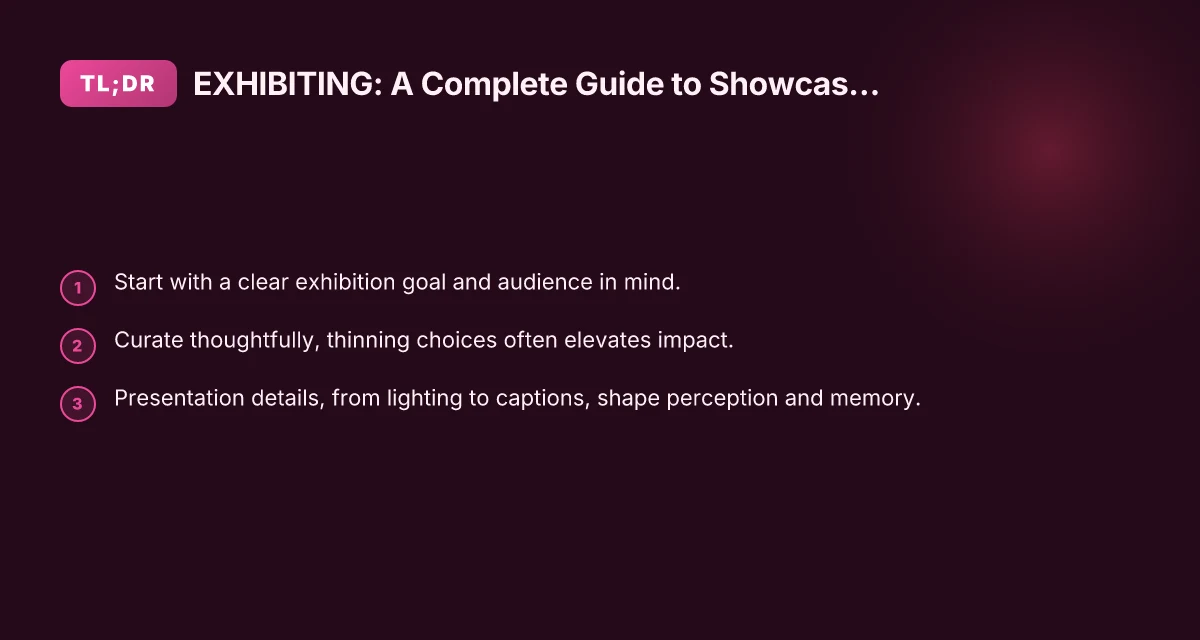
- Start with clarity: define purpose, audience, and a strong concept.
- Curate with intention: less is often more. Curate to create coherence.
- Invest in the details: lighting, labels, accessibility, and signage influence perception.
- Build a strong opening moment: a focal piece or a compelling entry experience.
- Plan for accessibility: consider physical, cognitive, and sensory accessibility from day one.
- Foster interaction without overwhelming: provide optional programs and spaces for reflection.
- Document thoroughly: keep records for future loans, catalogs, and shared learning.
- Be adaptable: exhibitions evolve. Stay open to feedback and on-site refinements.
- Think beyond the walls: coordinate digital extensions to reach broader audiences.
If you’re new to exhibiting, start with a modest project that aligns tightly with your goals and audience. As you gain experience, gradually scale and diversify formats, solo shows, group shows, pop-up installations, or online exhibitions. The core is not simply presenting objects. It’s telling a compelling story in a way that invites viewers to pause, reflect, and remember. With thoughtful planning and hands-on execution, your next exhibition can be both artistically fulfilling and audience-winning. 出展者一覧: A Comprehensive Guide to Understanding Exhibitor Lists
沈清禾负责免费VPN实测,记录流量上限、速度限制、广告和隐私条款。