BUILDING MAINTENANCE HUMAN FAIR & CLEAN EXPO 2017
A comprehensive overview of the BUILDING MAINTENANCE HUMAN FAIR & CLEAN EXPO 2017, its purpose, highlights, and key takeaways.
The BUILDING MAINTENANCE HUMAN FAIR & CLEAN EXPO 2017 gathered facility managers, contractors, and suppliers to explore humane, efficient, and clean building maintenance. The event highlighted best practices, new technologies, and collaborative approaches that prioritize occupants’ health and environmental stewardship. Below is a detailed look at what the expo offered, who attended, and what you could take away if you were there or planning to attend similar events.
Comparison of sustainable cleaning products vs traditional options
| Criterion | Sustainable option | Traditional option | Notes |
|---|---|---|---|
| Environmental impact | Lower footprint | Higher footprint | life-cycle focus |
| Use of eco-certifications | Yes | Sometimes | e.g., Green Seal, Ecolabel |
| Toxicity to occupants | Lower | Higher | incidental exposure potential |
| Packaging waste | Recyclable/biodegradable | Mixed/non-recyclable | packaging emphasis |
| Cost perception | Comparable or slightly higher | Often lower upfront | lifecycle cost matters |
| Effectiveness on tough soils | Yes / effective | Yes / effective | performance varies by product |
| Biodegradability | Fully or mostly | Limited | rate depends on formula |
| Availability | Broad in markets | Broad | distribution networks |
| Training needs | Moderate | Low | usage and dosing guidance |
| Supplier support | Strong | Moderate | technical assistance |
Compiled November 2026; check the provider's site for current details.
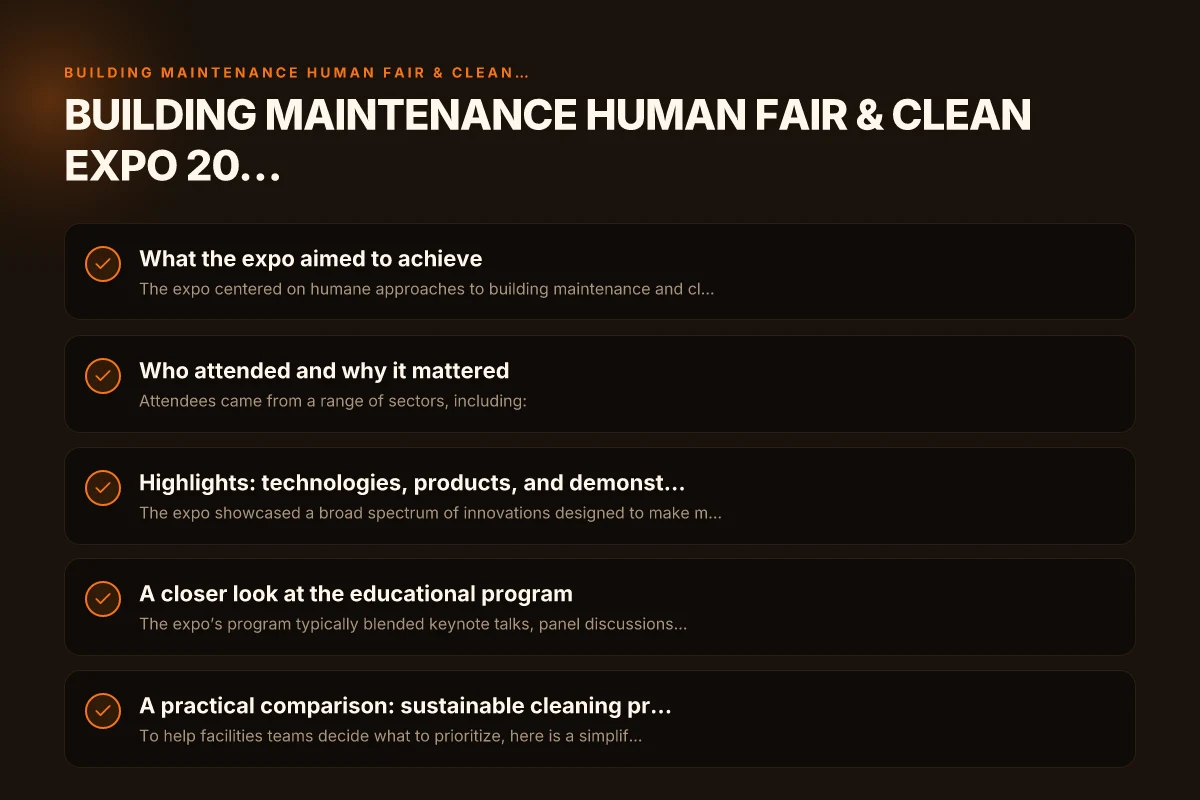
What the expo aimed to achieve
The expo centered on humane approaches to building maintenance and cleaning. Goals included:
- Reducing indoor air contaminants and chemical exposure
- Improving worker safety and well-being
- Promoting sustainable cleaning agents and water use
- Encouraging maintenance strategies that minimize downtime and disruption
- Fostering collaboration between building owners, facility managers, and service providers
Key themes were sustainability, transparency, and accountability. Attendees could compare products, listen to expert talks, and connect with potential partners who shared a commitment to humane and clean environments.
Who attended and why it mattered
Attendees came from a range of sectors, including:
- Corporate facilities teams managing large campuses
- Schools and universities seeking healthier classrooms
- Hospitals and care facilities prioritizing infection control and safe products
- Real estate developers and building owners aiming for greener certifications
- Cleaning service providers and equipment manufacturers
Why it mattered: the expo offered a convergence point for buyers prioritizing human-centered design in maintenance and for suppliers who could demonstrate the real-world impact of their products and services. Networking, live demonstrations, and case studies provided practical context beyond brochures. 出展料金: A Practical Guide to Understanding and Budgeting for Trade Show Participation
Highlights: technologies, products, and demonstrations
The expo showcased a broad spectrum of innovations designed to make maintenance more humane and cleaner. Highlights often included:
- Green cleaning products: low-toxicity formulas, biodegradable agents, and fragrance-free options
- Hygiene and air quality solutions: HEPA filtration, UV-C disinfection, portable air cleaners
- Exposure reduction tools: ergonomic equipment, safer chemical handling systems, and touchless technologies
- Waste and water management: efficient cleaning workflows, wastewater minimization, and recycling initiatives
- Digital maintenance platforms: work orders, asset tracking, and performance analytics
Demonstrations allowed attendees to see how products perform in real-world settings and provided immediate feedback on usability, safety, and maintenance impact.
A closer look at the educational program
The expo’s program typically blended keynote talks, panel discussions, and hands-on workshops. Common topics included:
- Health and safety for cleaning staff: training, PPE selection, and risk assessment
- Indoor environmental quality: how cleaning routines affect occupant well-being
- Sustainable procurement: evaluating suppliers for environmental and social governance
- Operational efficiency: reducing downtime and extending equipment life
- Compliance and standards: aligning with local regulations and industry best practices
Presentations often featured building operators sharing successful case studies, alongside product developers explaining the science behind their innovations. 出展対象: A Practical Guide to Identifying Your Exhibition Targets
Comparison of educational program formats at the expo
| Format | Interactive demonstrations | Workshops | Lectures | On-site tours | Q&A sessions | Accessibility notes |
|---|---|---|---|---|---|---|
| Hands-on learning | Yes | Yes | No | Yes | Yes | ADA compliant options |
| Depth of content | Practical | Skill-building | Theory-oriented | Contextual | Clarifying | varies by track |
| Duration per segment | Short to mid | Mid | Short to mid | Variable | Short | scheduling blocks |
| Audience suitability | All levels | Practitioners | Professionals | Facility teams | All | translation if needed |
| Certification/credit | Some | Yes | Some | No | Yes | CPD credits possible |
| Materials provided | Yes | Yes | No | Yes | Yes | digital copies available |
Compiled November 2026; check the provider's site for current details.
A practical comparison: sustainable cleaning products vs traditional options
To help facilities teams decide what to prioritize, here is a simplified comparison that might mirror what you’d see at the expo:
| Factor | Sustainable/Green Cleaning Products | Traditional Cleaning Products |
|---|---|---|
| Toxicity | Low or no harsh solvents; safer for workers and occupants | Can contain stronger chemicals; higher exposure risk |
| Environmental impact | Biodegradable, reduced aquatic toxicity, safer packaging | Higher persistence in environment; more plastic waste |
| Indoor air quality | Generally improved due to lower VOCs | Higher VOC release can affect IAQ |
| Cost considerations | Often competitive over life cycle; some premium upfront | Lower initial cost but potential higher long-term costs |
| Worker safety | Improved, with clearer labeling and safer handling | Greater handling risk; more PPE required |
| Performance | Effective for most tasks; ongoing product development | Reliable but may rely on harsher formulations |
Notes: 出展者一覧: A Comprehensive Guide to Understanding Exhibitor Lists
- The table simplifies common tendencies. Actual product performance varies by brand and use case.
- When evaluating products, weigh total cost of ownership, including health and safety benefits and environmental impact.
Practical takeaways for facility managers
If you’re structuring a maintenance program inspired by the expo, consider these actionable steps:
- Audit current cleaners and chemicals: identify high-toxicity products and potential substitutions
- Prioritize air and water quality: invest in filtration, filtration maintenance, and low-emission equipment
- Train maintenance staff: emphasize safe handling, ergonomic practices, and incident reporting
- Adopt a phased procurement approach: pilot green products in one site, measure outcomes, then scale
- Engage occupants: communicate cleaning schedules, IAQ improvements, and safety measures to boost trust
- Track results: set metrics for chemical exposure, waste reduction, water use, and energy impact
Practical takeaways for facility managers: actionable steps vs notes
| Area | Actionable steps | Priority | Expected outcome | Responsible party | Timeframe |
|---|---|---|---|---|---|
| Cleaning products | Switch to eco options | High | Lower toxins | FM team | 0-3 months |
| Training | Schedule hands-on trainings | Medium | Correct use | Safety supervisor | 1-2 months |
| Waste management | Improve recycling program | High | Less waste | Building ops | 1-6 months |
| Energy use | Optimize equipment idle times | Medium | Energy savings | Tech staff | 3-6 months |
| Documentation | Update SOPs | Medium | Compliance | FM manager | 1-2 months |
| Vendor management | Align with certified vendors | Low | Assurance | Procurement | 2-4 months |
Compiled November 2026; check the provider's site for current details.
Lessons from real-world case studies
Many exhibitors shared case studies where humane and clean maintenance yielded tangible benefits: 来場対象: Who Can Attend and How to Determine Eligibility
- Reduced illness-related absenteeism in office settings after switching to low-emission cleaners
- Improved IAQ in classrooms leading to better student concentration and comfort
- Lower maintenance downtime by using modular, safer equipment that’s easier to service
- Cost savings over time due to reduced chemical inventory, safer handling, and fewer health-related incidents
Findings vary by building type and usage. The common thread is that humane, clean maintenance aligns safety, health, and operational efficiency.
The role of policy, standards, and certification
The expo often emphasized alignment with standards and certification programs, such as:
- Green Cleaning certifications that recognize low-toxicity products and practices
- Indoor air quality guidelines that tie cleaning schedules to occupant health
- Occupational safety programs focusing on ergonomic practices and PPE
- Waste reduction and water management certifications that encourage resource stewardship
For facility teams, pursuing certifications can provide a framework for continuous improvement and a credible signal to occupants and stakeholders.
Final section: recommendations to apply learning from BUILDING MAINTENANCE HUMAN FAIR & CLEAN EXPO 2017
- Start with a humane cleanliness strategy: define what “human fair and clean” means for your buildings, focusing on occupant health, staff safety, and environmental impact.
- Build a phased procurement plan: test green products in a controlled setting, measure outcomes, and scale based on data rather than hype.
- Invest in people: training, safety culture, and clear communication with occupants are as important as products and technologies.
- Leverage partnerships: collaborate with suppliers who demonstrate transparent reporting, field performance, and support for sustainable practices.
- Set measurable goals: establish clear metrics for IAQ, chemical exposure, waste, water use, and downtime, and review them regularly.
If you’re planning or reviewing a BUILDING MAINTENANCE program today, using the lessons from the 2017 expo can help you design a more humane, cleaner, and more efficient operation. The emphasis on collaboration between building teams and suppliers, coupled with practical demonstrations and robust standards, remains relevant for facilities of any size and purpose. 2018年度実績: A Comprehensive Look at the 2018 Performance and Outcomes
沈清禾负责免费VPN实测,记录流量上限、速度限制、广告和隐私条款。